Why Fraud, Identity and AI Are Now Inseparable
As financial services accelerate toward 2026, fraud, identity and artificial intelligence are no longer separate domains. They are becoming deeply interconnected elements of a single trust architecture. The rise of AI-powered fraud, synthetic identities and deepfake technologies is fundamentally reshaping how financial institutions must think about risk and verification.
Industry research and global fraud reports consistently highlight a critical shift. Fraud is becoming faster, more automated and more difficult to detect using traditional methods. Static rules, manual reviews and one-time identity checks are increasingly ineffective against attacks that evolve in real time.
Synthetic Identity and Deepfake Threats
One of the most significant challenges financial institutions face today is the rapid growth of synthetic identity fraud. By combining real and fabricated personal data, fraudsters can create identities that pass traditional verification checks while remaining difficult to trace.
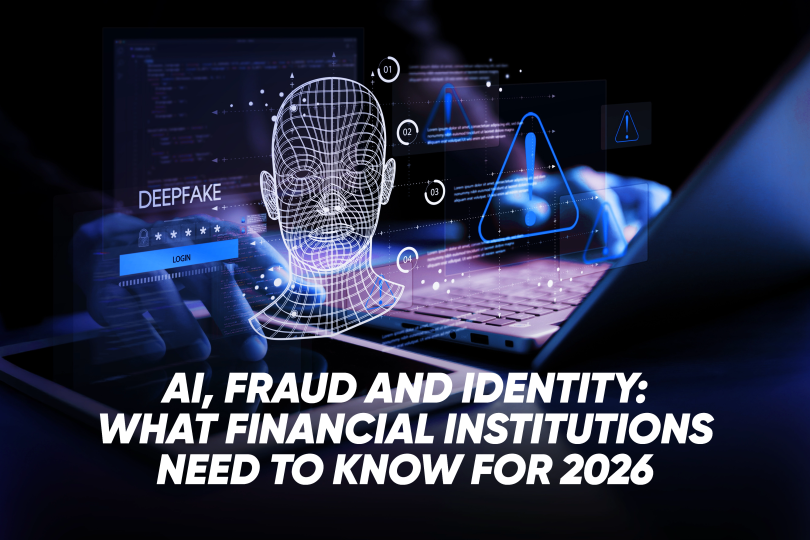
At the same time, advances in deepfake technology have made face manipulation, voice cloning and presentation attacks far more convincing. These techniques are no longer limited to high-profile cases. They are becoming accessible, scalable and increasingly used in financial fraud scenarios.
Reports from identity verification and fraud prevention providers show that these threats are not isolated incidents. They represent a structural shift in how fraud is executed, demanding equally advanced countermeasures.
Why AI-Supported Fraud Detection Is No Longer Optional
As fraud techniques grow more sophisticated, AI-supported fraud detection is becoming a necessity rather than an enhancement. AI models can analyze vast volumes of behavioral, transactional and contextual data in real time, identifying subtle patterns that traditional systems would miss.
Unlike rule-based systems, AI-driven fraud detection continuously learns and adapts. This enables institutions to respond proactively to emerging threats rather than reacting after damage has occurred. In a landscape shaped by AI-driven fraud, only AI-driven defense can operate at the required speed and scale.
Continuous Identity as a New Standard
Identity verification is also undergoing a fundamental transformation. Instead of being a one-time checkpoint during onboarding, identity is becoming a continuous process that spans the entire customer lifecycle.
Continuous identity enables institutions to maintain trust beyond the first interaction. By monitoring behavior and context over time, systems can detect anomalies that indicate account takeover, fraud attempts or identity misuse, even long after onboarding is complete.
This shift reflects a broader industry consensus. Trust is no longer established once. It must be maintained continuously.
Risk-Based Verification Models
Not every interaction carries the same level of risk. Risk-based verification models address this reality by dynamically adjusting verification requirements based on context, behavior and transaction characteristics.
Low-risk interactions can remain fast and seamless, while higher-risk scenarios trigger stronger verification steps. This approach allows institutions to strengthen security without introducing unnecessary friction, a balance that is increasingly critical in competitive digital markets.
Balancing Customer Experience and Security
One of the most persistent challenges in financial services is balancing customer experience with security. Historically, institutions were often forced to choose between the two. In 2026, that trade-off is no longer acceptable.
AI enables security and experience to coexist. Intelligent orchestration ensures that protection is applied precisely where and when it is needed, while legitimate users experience smooth, uninterrupted journeys. The result is a more resilient and customer-centric security model.
Enqura Perspective
In 2026, fraud prevention is no longer about isolated controls or standalone tools. It is about building an AI-driven trust architecture where identity, behavior and risk intelligence operate together in real time.
At Enqura, we believe the future of digital finance depends on transforming intelligence into trust. By integrating AI into identity verification, fraud prevention and customer journeys, financial institutions can deliver secure, seamless and future-ready experiences without compromise.